


The Engineered Coupling of Wedge and Clip: A Systems Analysis of Tile Leveling Mechanics
The modern pursuit of a perfectly planar tile surface has evolved from a test of manual dexterity to an exercise in applied mechanical engineering. Central to this evolution is the clip-and-wedge leveling system, a tool whose efficacy is fundamentally misrepresented when its parts are considered in isolation. The true innovation resides not in the clip or the wedge as discrete objects, but in their deliberate coupling-a premeditated synergy where each component's form and function are entirely contingent upon the other. This partnership creates a unified force-management system, transforming a simple hammer strike into a calibrated, two-axis clamping event. This analysis moves beyond descriptive overviews to examine the leveling system as an integrated mechanical assembly, exploring the principles of force transmission, material dialogue, and fail-safe design that make this coupling not just beneficial, but essential for predictable, high-precision tile installation.

Reconceptualizing the System: From Parts to an Integrated Assembly
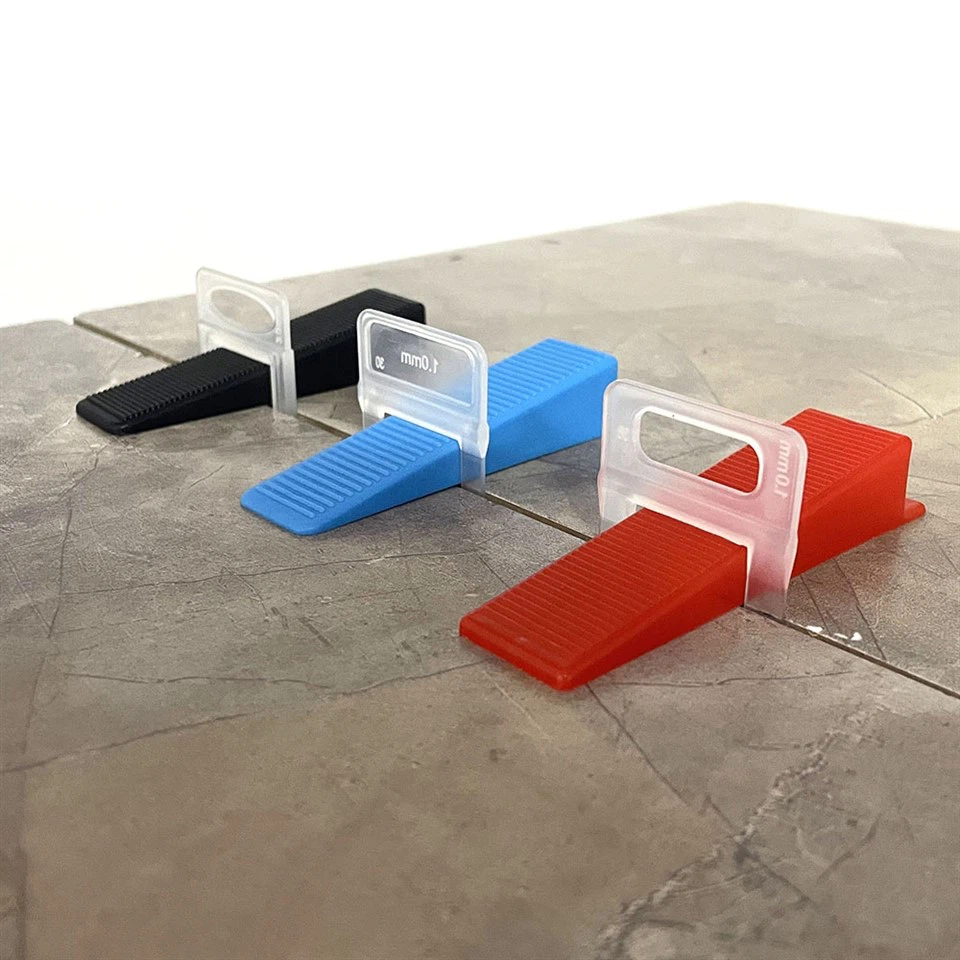
The prevailing misconception views the clip and wedge as sequential tools: first place the clip, then drive the wedge. A more accurate model is that of a single, deployed mechanism. The clip serves as the static reaction structure-the "chassis"-designed with specific engagement geometry and tensile pathways. The wedge acts as the linear actuator, a moving element that mates with this chassis. Their relationship is analogous to a ratchet and pawl, or a bolt and nut; one is incomplete and functionally inert without the precise dimensions and properties of its counterpart. This intrinsic dependency is the bedrock of the system's reliability, ensuring that force application is never arbitrary but always channeled through a predefined, optimized mechanical path.

The Mechanical Transmission of Energy
The core operation is a precise energy conversion. The installer's kinetic energy (hammer strike) is the input. The wedge, an inclined plane, acts as a static force transformer. Its critical function is to resolve the installer's vertical impulse into a new vector: a powerful horizontal displacement. However, without the clip, this horizontal motion is wasted. The clip's role is to capture this displacement. Its engineered socket acts as a stationary, angled reaction surface that intercepts the wedge's horizontal movement. The interaction between the moving wedge face and the stationary clip socket creates a reaction force that is transmitted upward through the clip's body, applying the desired downward tensile force on the tile edge. Simultaneously, the wedge's attempt to spread the clip's socket apart is resisted by the clip's hoop strength, generating the secondary inward compressive force on the tiles.

Deep Dive: The Wedge as a Precision Actuator and Force Limiter
The wedge is a disposable machine element, designed for a single, high-load actuation cycle.
Geometry as the Governing Performance Parameter
The wedge's taper ratio (length of slope to height) defines its mechanical advantage. However, the optimal ratio is a compromise. A very low ratio (e.g., 3:1) allows quick engagement but requires high input force, risking tile shock. A very high ratio (e.g., 8:1) provides immense force multiplication but results in an impractically long wedge that is prone to buckling. Professional systems typically employ a ratio between 4:1 and 6:1. Furthermore, the wedge may have a compound or slightly concave taper to concentrate the final clamping force in the last few millimeters of travel, providing a more positive "seat."
Material and Design for Controlled Actuation and Failure
The wedge's material demands differ from the clip's:
- High Compressive Strength and Hardness: Materials like Polyoxymethylene (POM/Acetal) are favored for their high compressive strength, low moisture absorption, and excellent fatigue resistance. The wedge must not deform ("mushroom") under repeated hammer strikes.
- The Shear Neck as a Prescribed Failure Point: The notch or thin section is a stress concentrator. Its location and depth are calculated so that the shear stress from a twisting motion exceeds the material's shear strength before the torque required to break the clip's strap is reached. This ensures the wedge fails first, protecting the tile from prying forces.
- Head Design for Energy Transfer: The strike face is often slightly domed or concave. This geometry helps to self-center a round mallet face, directing the impact force co-axially with the wedge to prevent bending moments that could misalign it in the clip.
The Interface: A Study in Precision Fit and Friction Management
The mating of wedge and clip is a study in controlled interference fit, a common principle in precision mechanics.
The Regime of Controlled Interference
An ideal fit is not "snug" but a calculated interference fit. The wedge is manufactured to be fractionally larger than the clip's socket at any given point along the taper. This means:
- Upon initial hand-insertion, only the very tip makes contact, requiring minimal force.
- As the wedge is driven, the interference increases progressively. The elastic deformation of the clip's socket walls creates a normal force, which in turn generates high static friction, locking the wedge in place.
- This progressive interference creates the characteristic feeling of smooth, increasing resistance, culminating in a firm, positive stop. The stop is not the wedge hitting "bottom" in a void; it is the point where the elastic limits of the materials and the designed interference reach equilibrium with the installer's applied force.
Mixing components destroys this calibration. A wedge from System A, even if it seems to fit, will have a different interference profile with a clip from System B, leading to inconsistent seating force, potential for under- or over-tightening, and unreliable clamp load.
Dynamic Friction as a System Feature
Friction at the interface is not a bug but a critical feature. The static friction coefficient must be high enough to prevent the wedge from vibrating loose under job-site impacts or "backing out" due to elastic recovery in the system. Dynamic friction (during driving) must be low and consistent to allow smooth travel. This is achieved through material pairing-often a harder wedge material (POM) against a slightly softer, internally lubricated clip socket material.

The Operational Cycle: A Phased Analysis of System States
The coupled system transitions through distinct mechanical states from deployment to decommissioning.

State 0: Pre-engagement (Components Separate)
The clip is placed, acting as a passive alignment guide. The wedge is a separate actuator.
State 1: Engagement & Elastic Deformation
The wedge is started, establishing initial contact. The clip socket begins to elastically deform outward as the wedge enters the interference zone.
State 2: Active Clamping & Plastic Region Approach
Hammer strikes drive the wedge. The clip material is stressed within its elastic limit. Tensile load ramps up linearly in the strap. The tile is pulled into plane. The system stores significant elastic strain energy.
State 3: Dwell (Metastable Equilibrium)
The wedge is seated. The system is in static equilibrium: the tensile force in the clip strap is balanced by the shear resistance of the mortar anchor and the friction at the tile interface. The stored elastic energy applies constant pressure, counteracting mortar shrinkage.
State 4: Decommissioning (Plastic Failure of Fuses)
A twisting torque is applied. Stress concentrates at the wedge's shear neck, exceeding the material's ultimate shear strength-it fails plastically. The now-reduced torque is transferred to the clip's strap, which is then bent, concentrating stress at its root until it fractures in tension. The system is disassembled via controlled, sequential failure.
Comparative Analysis: Coupled System vs. Uncoupled Alternatives
| Aspect | Engineered Coupled System | Uncoupled/Improvised Methods |
|---|---|---|
| Force Calibration | Clamp load is predetermined by geometry and stop design. Consistent and repeatable. | Load is dependent on installer strength and judgement. Highly variable. |
| Force Vector | Dual-axis (downward pull + inward squeeze) is inherent to the coupled design. | Typically single-axis (downward only). Lateral alignment is separate. |
| Stored Energy | Elastic strain energy in the stretched clip maintains constant pressure during cure. | Relies on mortar's initial grip; pressure diminishes as mortar shrinks/relaxes. |
| Failure Mode | Prescribed, safe failure of sacrificial components during removal. | Uncontrolled; often requires prying, risking damage to tile or adhesive bond. |
| Process Integration | Installation and removal are integral, low-skill phases of the system's cycle. | Removal is an afterthought, often a high-skill, high-risk task. |
System Integration with Substrate and Mortar
The clip-wedge assembly does not function in isolation; it is part of a larger structural composite.
The Mortar as a Viscous Damping Medium
The mortar bed is more than an adhesive; it is a viscous medium that must transmit the clamp force evenly across the tile's back. The inward compressive component of the wedge-clip force is particularly effective at consolidating this mortar layer, pushing out entrapped air and ensuring full coverage. The system is designed to apply pressure over the 12-24 hour curing window, actively compensating for the mortar's volumetric reduction during setting, a process known as "plastic shrinkage."
Adaptation for Material and Scale
The coupling parameters are tuned for application. For large, heavy tiles, the system might use a wedge with a higher mechanical advantage and a clip with a wider, more robust tensile strap. For sensitive materials, the interference fit or the stop point might be designed to limit maximum clamp force, preventing over-stress. The fundamental coupling principle remains, but the "tuning" of the parts is adjusted.
"Think of it as a disposable ratchet strap for your tiles. The clip is the hook and the strap. The wedge is the ratchet handle. You can have the world's best hook, but without the ratchet mechanism, it's just a hook. And the ratchet is useless without the strap to take the tension. They're one tool. The brilliance is that the 'ratchet' is designed to break off cleanly when you're done." – Marcus Thorne, Mechanical Engineer & Tile Installation Consultant
Frequently Asked Questions (FAQ)
If the fit is so precise, why do wedges sometimes feel slightly different from one to the next?
Microscopic variations are inherent in mass production. High-end systems control these to within a few microns. The "feel" can also be affected by temperature (materials expand/contract) and the presence of microscopic dust. However, within a quality-controlled batch, the variance should be minimal and not impact the final clamp load. Consistent mortar consistency is actually a larger variable in final result.
Could this system be made from metal for even greater strength?
While metals offer higher strength, they introduce disadvantages: higher cost, weight, corrosion potential, and, critically, a lack of the controlled failure mode. The polymer's ability to be engineered with a precise shear neck and fracture strap is key to safe, easy removal. Metal would also risk damaging tiles. Polymers provide an ideal balance of strength, lightweight, corrosion resistance, and designed failure.
Does the "click" or seating feel mean I've applied the maximum possible force?
Not necessarily maximum, but the designed force. The stop is engineered to indicate the system is fully tensioned within its operational parameters. Applying force beyond this "stop" is over-torquing. It strains components beyond their elastic limit, risks damaging tiles, and does not significantly increase the beneficial clamping force on the tile, as the load path may yield.
How does joint width selection (e.g., 2mm vs. 3mm) physically alter the coupling?
It changes the clip's stand-off height, which alters the leverage arm. A taller clip (for a wider joint) has a slightly longer moment arm from the tile edge to the mortar anchor. The system may be subtly re-tuned to account for this-a slightly different wedge taper or a clip with a wider anchor base for stability-to ensure the force application remains optimal. The color coding is a safeguard to maintain the correct component pairing for the chosen joint geometry.
Foundational Tenets of the Coupled System
- Unified Functional Entity: The clip and wedge constitute a single, deployable mechanical fastening system, not two separate tools.
- Calibrated Interdependence: Every performance characteristic-mechanical advantage, clamp load, failure point-emerges from the interaction of the paired components' geometries and material properties.
- Managed Energy Pathway: The system provides a dedicated, low-loss pathway to convert installer energy into targeted tile alignment force.
- Designed Lifecycle: The system encompasses a full lifecycle: elastic deployment, sustained load holding, and safe decommissioning via sequential sacrificial failure.
- Inviolable Pairing: System performance is a warranty of component pairing. Substitution or mixing invalidates the engineering and guarantees sub-optimal results.
Conclusion: The Intelligence of Constrained Interaction
The clip-and-wedge leveling system stands as a paradigm of elegant engineering, where intelligence is embedded not in complexity, but in the meticulous design of a constrained interaction. Its power derives from the deliberate limitation of degrees of freedom between two simple parts, channeling force and intention with unerring precision. For the professional installer, mastering this system means understanding that they are not manipulating tiles directly, but rather operating a calibrated tool that performs the manipulation on their behalf. This shift-from artisan to systems operator-is what enables the consistent, repeatable perfection demanded by modern standards. The enduring value of the wedge and clip lies not in the plastic they are molded from, but in the immutable physical conversation they are designed to have with each other, a conversation that reliably translates a simple tap into a perfectly flat plane.
Hot Tags: wedge and clip tile leveling system synergy, China, manufacturers, suppliers, factory, customized, wholesale, buy