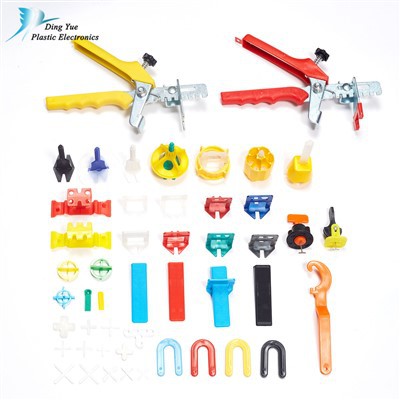


Let me start with a confession. Early in my tiling career, I was stubborn. I prided myself on my "eye" for leveling and my steady hands. Why would I spend extra money on clips and wedges when I could just tap a tile into place with a mallet and some spacers? It seemed like a scam to sell more plastic to DIYers. My first big job, a sprawling 800-square-foot commercial space with large-format porcelain tiles, quickly humbled me. By the third day, callbacks were already happening. Tiles that looked perfect in the morning had developed noticeable lippage by the afternoon sun. My profit margin on that job vanished faster than the thinset I was scraping off my knees. That experience taught me a hard lesson: ignoring the physics of tile installation is the most expensive mistake you can make. Let's break down the real economic benefits of using a tile leveling system.

The Hidden Cost of "Good Enough" Leveling
We've all heard the saying, "Close enough for government work." In tiling, "close enough" is a financial time bomb. The quest to avoid spending a few hundred dollars on a tile leveling system often leads to three major economic drains: rework, callbacks, and damaged materials.
1. The True Cost of Lippage Callbacks
Lippage is the uneven edge where one tile sits higher than its neighbor. It's not just an aesthetic issue; in commercial spaces, it's a tripping hazard and a lawsuit waiting to happen. I've seen jobs where the GC had to bring the tile crew back three times to fix lippage that "appeared" after the floor cured. Each callback eats into your profit: you're paying for labor, travel time, and potentially new materials if the original tiles were damaged during removal. Worse, you're burning your reputation. Clients remember who left a dangerous floor. The irony is that a simple $200 investment in a leveling system could have prevented thousands in callback costs.
2. Material Waste: When "Tapping" Goes Wrong
Without a system, installers often over-tap tiles trying to force them flush. This compresses the subfloor or damages the tile edges. I've lost count of how many custom-bordered tiles I've had to scrap because the tapping process chipped the glaze beyond repair. Even worse, if the substrate isn't perfectly flat, tiles can crack under pressure. A cracked tile means another trip to the supplier, more labor to demo and replace, and potential delays. The cost of a few extra clips pales in comparison to the cost of replacing a $50 slab of natural stone because it cracked during installation.

3. Labor Inefficiency: The Treadmill Effect
Here's a dirty little secret of manual leveling: it's physically exhausting and slow. You're constantly stopping to check levels, adjusting spacers, and tapping. This constant starting and stopping kills your flow state. Over an eight-hour day, inefficiency compounds. A team using a proper leveling system can move 30-40% faster. That speed isn't just about getting home earlier; it's about taking on more jobs per year. More jobs mean more revenue. I've timed crews with and without systems. The difference is undeniable. The "skill" of eyeballing level becomes a bottleneck when you scale up.
How a Leveling System Pays for Itself
Let's get down to brass tacks. How does spending money save you money? The answer lies in fixed costs versus variable costs, and risk mitigation.
1. Fixed Costs vs. Variable Costs
A cost-effective leveling system operates on a simple principle: fixed costs versus variable costs. A basic kit of clips and wedges might cost $150 to $300 for a residential job. That's a fixed cost. Now, compare that to the variable costs of callbacks, rework, or wasted materials. If a callback requires 10 hours of labor at $75 an hour, plus materials, you're already at $750. Suddenly, the $300 investment looks like a bargain. On larger commercial jobs, the math is even starker. The system scales with the project. A single box of 500 clips can service thousands of square feet. The per-square-foot cost dwindles with scale.
2. Risk Mitigation: Protecting Your Profit Margins
Every job has risks. Subfloor imperfections, adhesive failures, or client changes. A leveling system is a hedge against one of the biggest risks: lippage-related failures. By eliminating that variable, you create a more predictable pricing model. You can quote jobs with confidence, knowing that your installation method is standardized. This predictability is crucial for cash flow and bidding competitively. You're no longer gambling on your crew's ability to "get lucky" with every tile. You're ensuring a consistent outcome, which protects your profit margins regardless of who is doing the labor.
3. The Intangible: Reputation and Referrals
This is harder to quantify but equally important. A flawless floor speaks volumes. Clients notice when they run their hand over a surface and feel zero bumps. This leads to referrals, which are the cheapest and most reliable form of advertising. I've picked up entire seasons' worth of work from a single satisfied client who happened to own a restaurant. The leveling system ensured the floor was perfect, which led to the referral. You can't put a price tag on that kind of organic growth.
Calculating the ROI: A Real-World Example
Let's run some numbers. Imagine you're bidding a 1,000-square-foot bathroom remodel with large-format tiles. Here's the scenario:
- Without a leveling system: You estimate 80 hours of labor at $60/hour ($4,800). You add a 10% buffer for unexpected issues ($480). Total estimated cost: $5,280. You bid $8,000, aiming for a $2,720 profit. However, you hit lippage issues requiring 16 hours of rework ($960). Your actual profit drops to $1,760. You also had to replace 3 tiles ($150). Final profit: $1,610. You're stressed, tired, and disappointed.
- With a leveling system: You invest $250 in clips and wedges. Labor estimate remains 80 hours ($4,800), but you reduce the buffer to 5% ($240) because the system reduces risk. Total estimated cost: $5,290. You bid $8,000. No lippage issues occur. Your profit is $2,710. You finish on time, feel confident, and the client loves the result.
In this scenario, the $250 investment generated an additional $1,100 in profit. That's a 440% ROI. The system didn't just save time; it directly increased your bottom line. This is the power of save time tiling strategies.

Common Misconceptions Debunked
I still hear these objections from time to time. Let's address them head-on.
"It Slows Down Installation"
This is the biggest myth. Yes, you have to place a clip under each tile. But you save time elsewhere. You eliminate the constant stopping to check levels with a straightedge. You reduce the amount of tapping required. You also speed up cleanup because the wedges are removed cleanly, leaving minimal adhesive residue. The net gain in speed often outweighs the initial placement time. Experienced crews adapt quickly and find a rhythm that makes the system feel like second nature.
"It's Just for High-End Jobs"
Not true. While high-end jobs benefit greatly, even small residential bathrooms see significant returns. The cost of a basic kit is negligible compared to the cost of a single callback. Plus, the skill of using a leveling system translates to better results on every job, regardless of budget. It's a tool that elevates your entire craft, not just luxury projects.
"The Clips Leave Marks"
Modern systems are designed to break off cleanly at the tile surface. Any minor mark is easily wiped away with a damp sponge while the thinset is still wet. I've never had a client complain about a mark that wasn't resolved in five seconds. The alternative-lippage-leaves permanent, unsightly gaps that can't be fixed.
Choosing the Right System for Maximum ROI
Not all systems are created equal. To maximize your tile leveling benefits, you need to choose wisely.
1. Match the System to Your Project
For small residential jobs, a simple clip-and-wedge system is usually sufficient. For large commercial projects or large-format tiles, a more robust system with reusable components might be better. Don't overspend on features you don't need, but don't cheap out on quality either. A flimsy system that breaks easily will only frustrate you and negate the benefits.
2. Consider Reusability
Some systems offer reusable wedges or clips. If you're doing multiple jobs, this can significantly reduce long-term costs. Factor in the potential resale value of unused components or the cost savings over time.
3. Training and Adoption
A system is only as good as the crew using it. Invest time in training your team on the proper installation and removal techniques. Rushing the process or using the wrong size wedges will lead to frustration and subpar results. Make sure everyone understands the "why" behind the system to ensure buy-in.
Conclusion: The Smart Investment
The economic benefits of using a tile leveling system extend far beyond the initial purchase price. It's about protecting your profit margins, reducing risk, and delivering consistent, high-quality results. In an industry where margins are tight and competition is fierce, efficiency is king. By investing in a reliable leveling system, you're not just buying a tool; you're buying peace of mind, a faster workflow, and a reputation for excellence. The question isn't whether you can afford to use a leveling system, but whether you can afford not to. Remember, in tiling, the smoothest surface isn't just a sign of skill-it's a sign of smart business.
Hot Tags: the economic benefits of using a tile leveling system, China, manufacturers, suppliers, factory, customized, wholesale, buy, 1 4 Tile Spacer, 4mm Tile Spacer, Disposable Tile Level System Clip, tile leveling spacer, Tile Leveling System For Large Tiles, Tile Leveling System National Tiles